
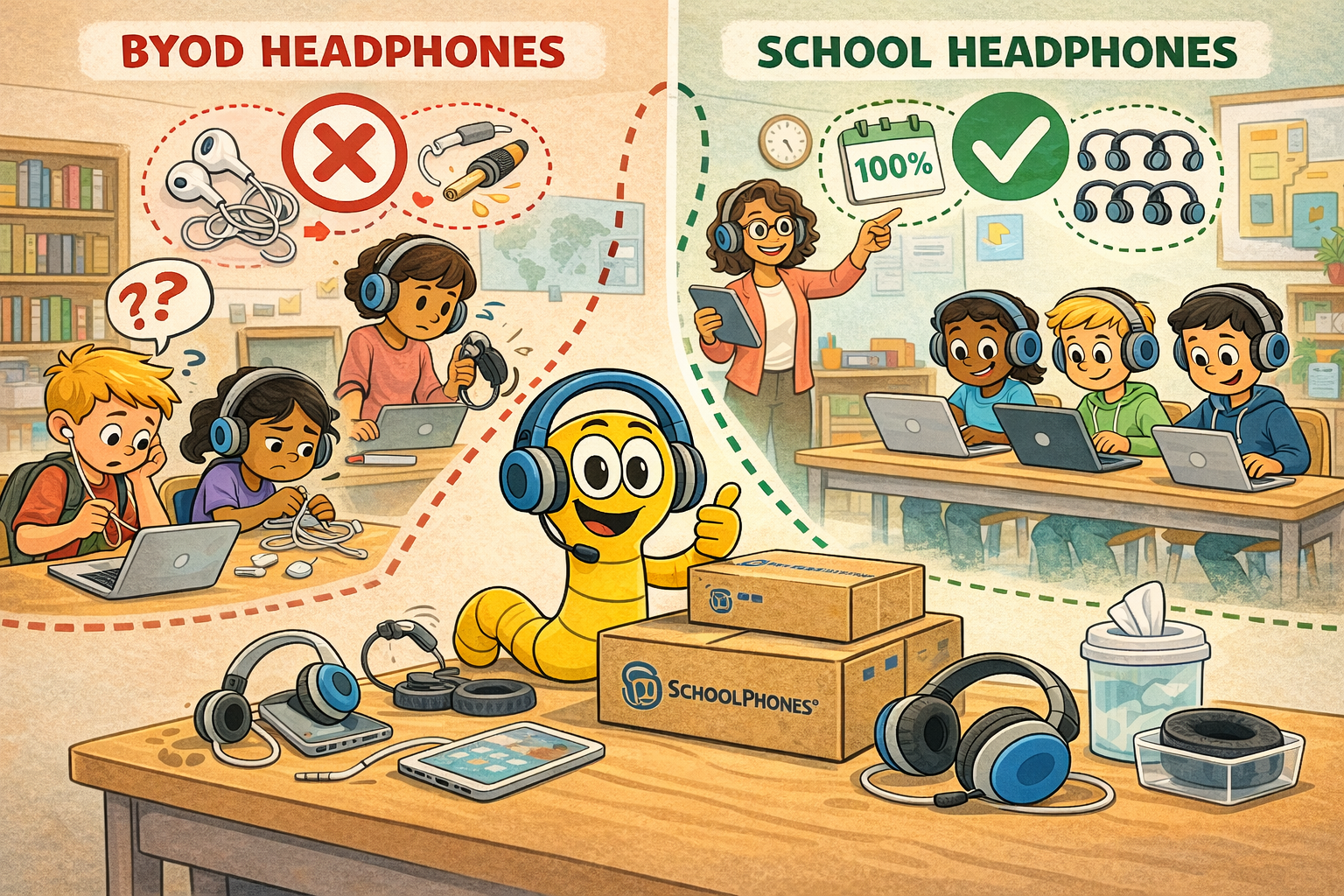
Many schools still rely on a “bring your own headphones” policy — and it’s costing them more in lost instruction time, hygiene concerns, and technology support than dedicated classroom headphones ever would. Here’s the case for standardizing on dedicated student headphones across your school or district.
The Hidden Costs of BYOD Headphones
When students bring their own headphones, classrooms face a cascade of daily disruptions:
- Forgotten headphones: 15-20% of students forget theirs on any given day, requiring sharing (hygiene risk) or sitting out of audio-dependent activities
- Incompatible connections: Student headphones may be Bluetooth-only, wireless with dead batteries, or wrong connector for school devices
- Distraction devices: Consumer earbuds can be hidden under hair, enabling students to listen to non-educational content
- Uncontrolled volume: No guarantee that student-owned headphones are volume-limited
- Breakage and drama: Expensive consumer headphones break at school, leading to parent complaints and student conflict
The Benefits of School-Provided Headphones
100% readiness, every day: When headphones live in the classroom, every student has working audio every day. No forgotten equipment, no compatibility issues, no excuses.
Consistent audio experience: Every student hears the same quality audio at the same safe volume level. This equity matters for assessments and instructional content.
Better hygiene management: School-owned headphones can be cleaned regularly and equipped with replaceable ear cushions. SchoolPHONES® headphones feature easy-wipe surfaces and optional replacement ear cushions for multi-student use.
Total cost of ownership is lower: A durable school headphone at $8-$25 per student lasts the full school year. Student-owned headphones break frequently, creating repeated parent expenses and classroom disruptions.
Implementation Models
1:1 assigned headphones: Each student gets their own pair, stored in their desk or Chromebook bag. Best for hygiene and accountability.
Classroom sets: 30 headphones per classroom, stored in a bin or caddy. More economical but requires cleaning between users.
Shared cart model: Headphones travel with a Chromebook or iPad cart. Good for schools where devices move between rooms.
Ready to make the switch? Browse our full catalog or contact us for a customized bulk quote.
Labeling and Assigning K-12 Headphones
A one-student-one-headset model only works if a student can find their own set in four seconds. Everything else about assignment is downstream of labeling.
- Label the headband, not the cable. Cables get replaced; the headband lasts the life of the headset. A permanent marker on the inside of the band survives cleaning and is invisible when worn.
- Number rather than name where you can. Numbers survive a student leaving mid-year, transfer cleanly between classes, and let you track a specific unit through a warranty claim.
- Write the in-service date on it. One line of marker under the headband on day one answers every warranty question later, because the warranty runs from when the headset entered service.
- Store them assigned. A Classpack unit holds 25 K6 or BK sets in numbered slots, which makes the set the student’s rather than the room’s.
The payoff is not tidiness. Assigned headsets are cleaner, last longer, and make hygiene manageable, because a set that belongs to one student is not a shared surface.
Replacement Cycles: What Actually Wears Out
Schools tend to budget for headphone replacement as though the whole unit fails at once. It rarely does. The wear is concentrated in two consumable parts:
| Part | Typical cause | Replace with |
|---|---|---|
| Cable | Pulled at the plug, rolled over, wound too tight | Replacement cable — $2.50 |
| Ear cushions | Compression and cleaning over a school year | 50 pairs — $45 |
| Headband | Rarely — polypropylene bends rather than snapping | Whole unit |
| Drivers | Rarely, outside of liquid damage | Whole unit |
A practical cycle for most buildings is to audit at the end of each year, replace cables and cushions over the summer, and retire only the units with a cracked band or a dead driver. That is what turns a yearly headphone purchase into a yearly parts purchase — the math is worked through on the district purchasing guide.
Warranty in 1:1 Versus Shared Use
Worth knowing before you choose a model, because the warranty follows how the headset is used rather than what you paid for it:
- K6 and BK series and accessories: one year in single-student assignment, 90 days in shared use.
- Lab Partner Jr. series and accessories: one year in both. This is why Lab Partner is the right specification for labs, listening centers and any cart that moves between rooms.
- Claims: email a photo of the damage with a short description. There is no RMA process to navigate first. Intentional damage and abuse are excluded.
The practical reading: if headsets are assigned to students, the classroom models carry a full year. If they are shared, either accept 90 days or specify Lab Partner and get the full year. Choosing on price alone without reading that line is how districts end up disappointed in month four.

Leave a Comment!