
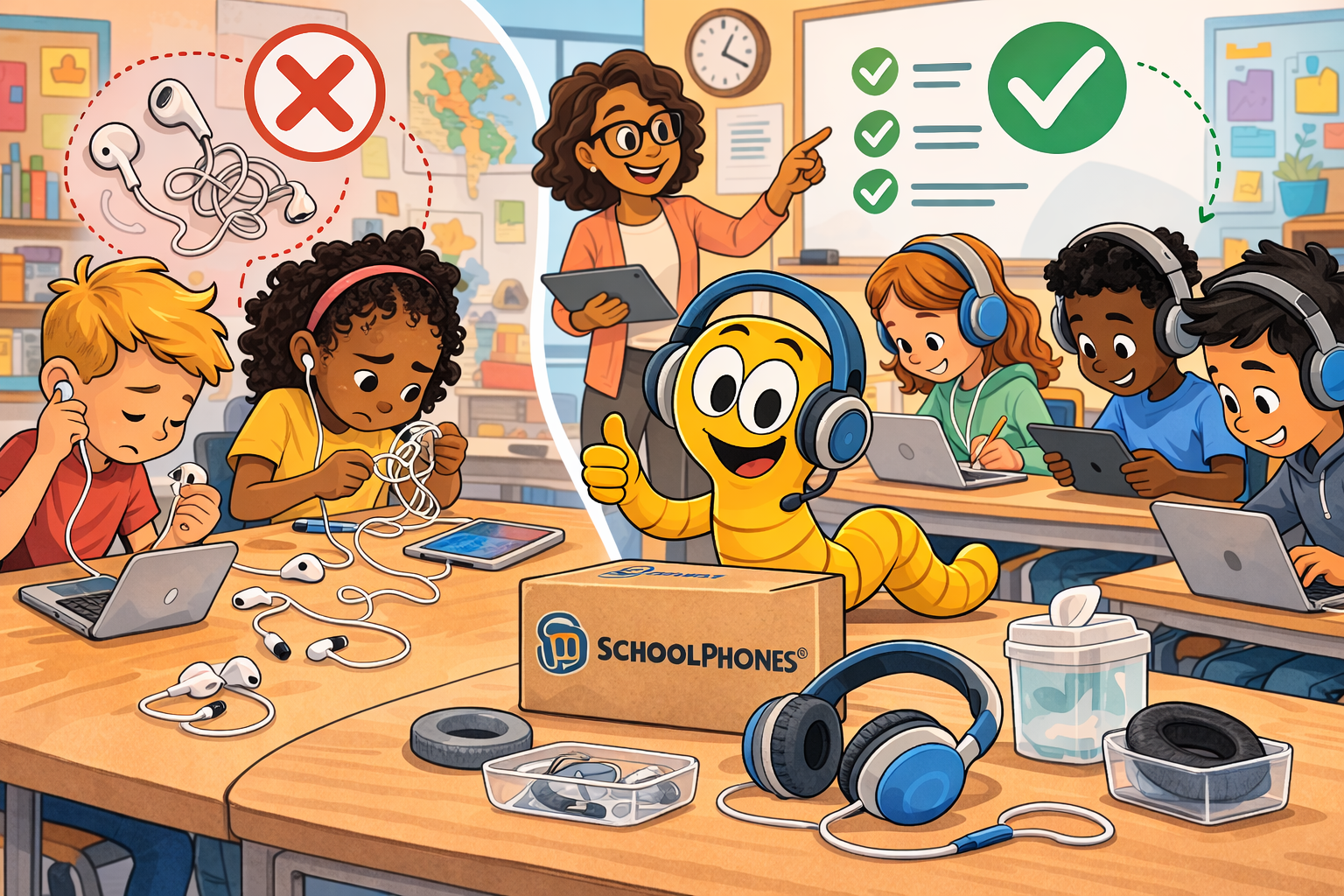
When budgeting for classroom audio, schools face a fundamental choice: headphones or earbuds? While earbuds are smaller and cheaper upfront, the real-world economics and practical considerations of school environments strongly favor over-ear headphones for most K-12 use cases.
Over-Ear Headphones: Advantages for Schools
- Durability: Over-ear headphones with reinforced headbands can last 2-4x longer than earbuds in school environments
- Hygiene: Ear cushions can be wiped down between students and replaced; earbuds that go in the ear canal are harder to sanitize for shared use
- Visibility: Teachers can see at a glance who is wearing headphones — important for classroom management and ensuring students aren’t secretly listening during instruction
- Comfort for testing: Over-ear designs are comfortable for 60-90+ minute testing sessions; earbuds cause ear fatigue and often fall out
- Passive noise isolation: Over-ear cups reduce ambient noise, helping students focus in busy classrooms
- Sizing: Adjustable headbands fit all head sizes; earbud tips often don’t fit younger children’s smaller ear canals
When Earbuds Make Sense
Earbuds can work for older students (high school) in 1:1 individual-use scenarios where hygiene isn’t shared-use concern. They’re ideal for personal devices and take-home programs. However, even in these cases, the durability advantage of over-ear headphones often outweighs the convenience of earbuds.
Cost Comparison: Total Cost of Ownership
Budget-friendly earbuds ($1-3 per pair) seem attractive, but replacement frequency tells the real story. In a typical classroom:
- Cheap earbuds: $2/pair × 4-6 replacements/year = $8-12/student/year
- Quality school headphones: $10-25/pair × 1 replacement/year = $10-25/student/year (with better audio quality, durability, and hygiene)
When you factor in teacher time spent distributing replacement earbuds and managing breakage, the headphone advantage becomes even clearer.
Explore SchoolPHONES® over-ear headphones by age group or request a quote for your classroom or school.
Hygiene: The Argument That Usually Settles It
An over-ear cushion sits against the outside of the ear and wipes clean in a second. An earbud goes into the ear canal. In a building where equipment is shared, that difference decides the question before cost or sound quality get a hearing.
- Over-ear cushions are replaceable. When they wear or a class needs a fresh set, you swap cushions rather than headsets, and disposable hygienic covers let you rotate shared sets between classes.
- Earbud tips are harder to clean and rarely replaced. In practice they get wiped and reissued, which is exactly the scenario school nurses raise.
- Head-lice protocol is simpler with over-ear. Replaceable cushions and smooth non-porous headband surfaces give you something to actually do, short of discarding the hardware.
Our care and cleaning guide covers the routine, including the end-of-year reset before storage.
Fit, Seal and Why It Changes Volume Behavior
A headphone that seals properly blocks room noise passively, which means a student hears detail without reaching for the volume control. A loose earbud does the opposite: it leaks, the student compensates with volume, and now you have a hearing-safety problem created by a fit problem.
This matters most in exactly the rooms where audio has to be reliable — testing sessions, reading intervention, language practice. It is also why sizing is treated as a specification rather than a grade label: the K6 series runs roughly 13–15 inches center to center of the speakers and the BK series about 14–16 inches, and a set that does not fit does not seal.
Testing Sessions: Where Earbuds Struggle Most
Three practical problems show up during assessments, and none of them are about sound quality:
- They fall out. A student reseating an earbud mid-passage has stopped attending to the question.
- Proctors cannot see whether they are worn. An over-ear set is visible from the front of the room; an earbud under hair is not, which matters where a program requires headphones to be in place.
- Wireless earbuds are the wrong tool entirely. Pairing, batteries and cross-connection to a neighboring device are failure modes a proctor cannot fix with the clock running. Testing platforms generally discourage or prohibit them.
For what individual programs expect, see our state testing requirements page and the standardized testing guide. If you are comparing on cost rather than principle, the district purchasing guide works through total cost of ownership over a fleet’s life.

Leave a Comment!