
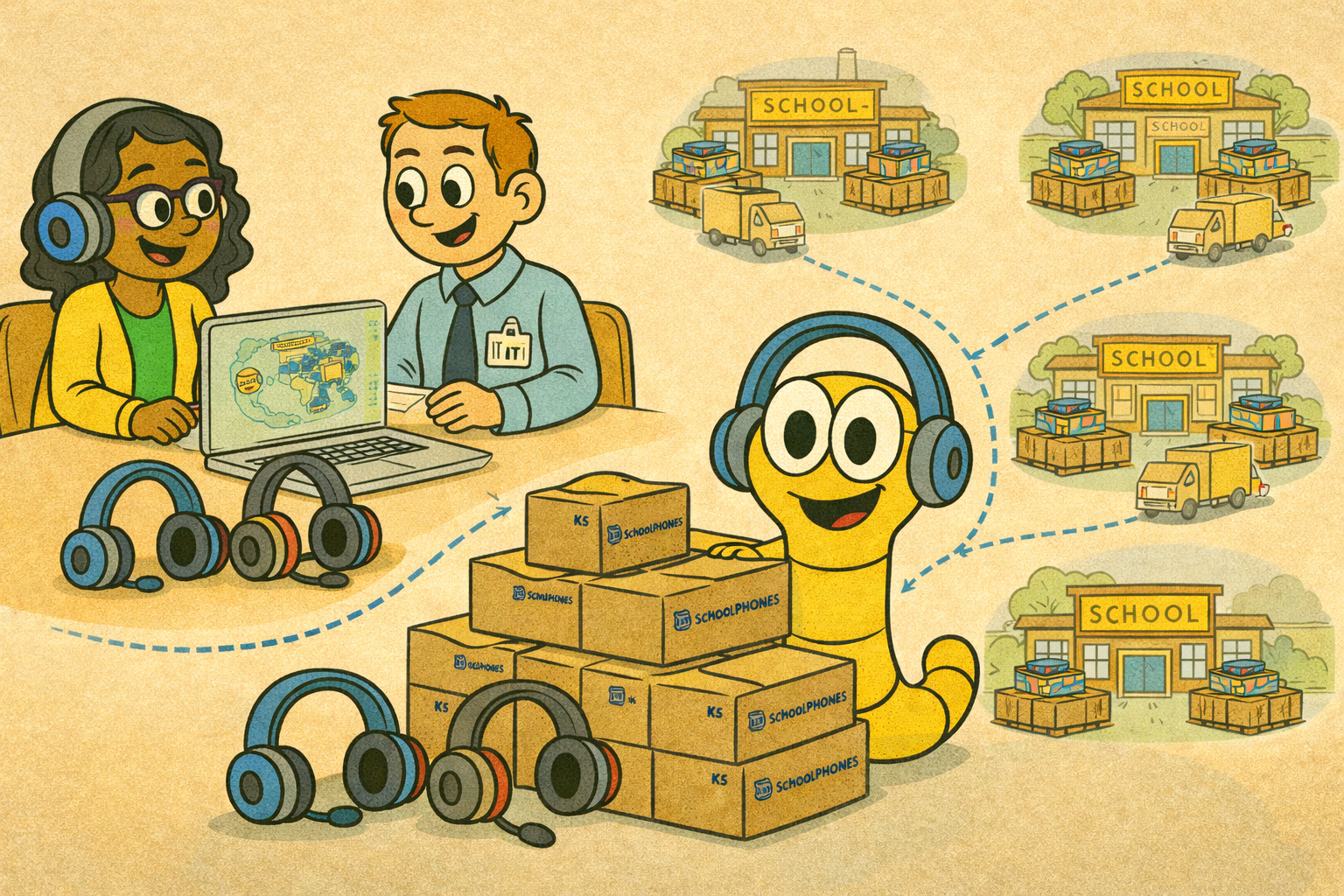
Purchasing headphones at the district level is fundamentally different from buying a few pairs for a single classroom. Volume negotiation, multi-site shipping logistics, standardization across schools, and procurement compliance all factor into the decision. This guide walks district technology coordinators and procurement officers through the bulk headphone purchasing process.
Why District-Level Standardization Matters
When each school in a district chooses its own headphones, you end up with a patchwork of models, quality levels, and compatibility profiles. Standardizing on a single headphone line delivers:
- Consistent student experience: Every school site delivers the same audio quality
- Simplified IT support: One model to troubleshoot, one set of compatibility specs
- Centralized replacement: Maintain a district warehouse of replacement parts (ear cushions, cables)
- Budget predictability: Known per-student costs across all sites
How to Scope a District Headphone Order
Step 1: Audit Your Device Fleet
Inventory the audio ports across your device fleet. Most districts run a mix of Chromebooks (3.5mm + USB-C), iPads (3.5mm on older, USB-C on newer), and possibly Windows laptops. The 3.5mm connection provides the most universal compatibility.
Step 2: Choose by Age Group
SchoolPHONES® recommends the K6 series for Pre-K through 4th grade (smaller heads, volume limiting) and the BK series for 5th grade through 12th grade (larger fit, full-range audio). For lab and shared-use environments, the LP/LPJ series provides maximum durability.
Step 3: Calculate Quantities
For 1:1 headphone programs, order one per enrolled student plus 10-15% spares. For classroom-set models, order per-classroom quantities plus spares. Include replacement ear cushions at 1 set per 2 headphones for mid-year refresh.
SchoolPHONES® District Purchasing Program
- Purchase orders accepted: Standard PO workflow for district procurement
- Multi-site shipping: Ship directly to individual schools from a single PO
- Simple ordering: The price you see is the price you pay, whether you are a single classroom or an entire district
- Samples program: Try before you buy with evaluation units
Contact us for a district-level quote or download our District Purchasing Guide.
What to Put on the Purchase Order
Most ordering problems are specification problems. A PO that says “student headphones, 500 units” leaves every decision that matters unmade. Five lines remove almost all of the ambiguity:
- Model, not series. “K6” is a family; K6S, K6D and K6M are different products at $9.35, $10.25 and $16.50. Write the model.
- Whether you need a microphone. S models have none, D models take a detachable SpringBoom™ mic, M models have one fitted.
- Connector. 3.5 mm TRS, 3.5 mm TRRS, USB-A or USB-C — driven by the devices in the room. See the Chromebook and computer and iPad compatibility pages.
- Volume limiting, if required. 85 dB hardware limiting is a K6 feature. BK is full range by design.
- Spares as separate line items. Cables and cushions ordered up front cost a fraction of replacing headsets later.
Purchase orders are accepted, and there is no minimum order and no volume tier — the per-unit price is the same for one headset or a thousand. Import tariffs appear as a separate surcharge line rather than inside the unit price; the reasoning is public.
Budgeting: Cost Per Student, Per Year
District budgets are annual, but headphones are not consumed annually. The number worth calculating is cost per student per year over the life of the fleet, and it is where repairable hardware separates from disposable hardware.
| Disposable consumer set | SchoolPHONES® K6D | |
|---|---|---|
| Unit cost | roughly $12–15 | $10.25 |
| When the cord fails | replace the headset | replace the cord — $2.50 |
| When cushions wear | replace the headset | replace the cushions — $0.90 a pair |
| Realistic service life | often a single year | several years with parts replaced |
| What you reorder each year | headsets | cables and cushions |
A district replacing entire headsets every year is buying the same product repeatedly. A district replacing cables and cushions is maintaining a fleet. The construction that makes that possible — an unbreakable polypropylene headband and modular parts — is the reason the math works.
Standardizing Across a K-12 District
The goal of a district standard is that any headset works in any room. That is achievable with two models rather than one, because head size does not follow grade neatly:
- Pre-K through early middle school: K6 series, roughly 13–15 inches center to center of the speakers, with 85 dB hardware limiting.
- Grade 5 through adult: BK series, roughly 14–16 inches, full range for music and media production.
- Labs and listening centers in either band: Lab Partner, for the full-year shared-use warranty.
Standardizing on the D models in both series gives a district one cable part number across the whole fleet, which is what makes the next device refresh a cable line item instead of a fleet replacement. Our bulk buying guide and the case for dedicated student headphones cover the operational side.
Warranty, Lead Times and Reordering
Two things worth knowing before the PO is cut, because they are easier to plan around than to discover:
- Warranty depends on how the headset is used. On K6 and BK models and their accessories it is one year in single-student assignment and 90 days in shared use. The Lab Partner series carries one year in both — which is why labs and listening centers should be specified on Lab Partner rather than classroom models.
- Claims are unbureaucratic. Send a photo of the damage with a short description. There is no RMA number to obtain first. Intentional damage and abuse are excluded.
For a district-level quote, evaluation units, or help matching models to a device fleet, the bulk order page is the fastest route, or call 800-286-3481. Schools with grant or voucher funding should also look at the school voucher program.

Leave a Comment!