
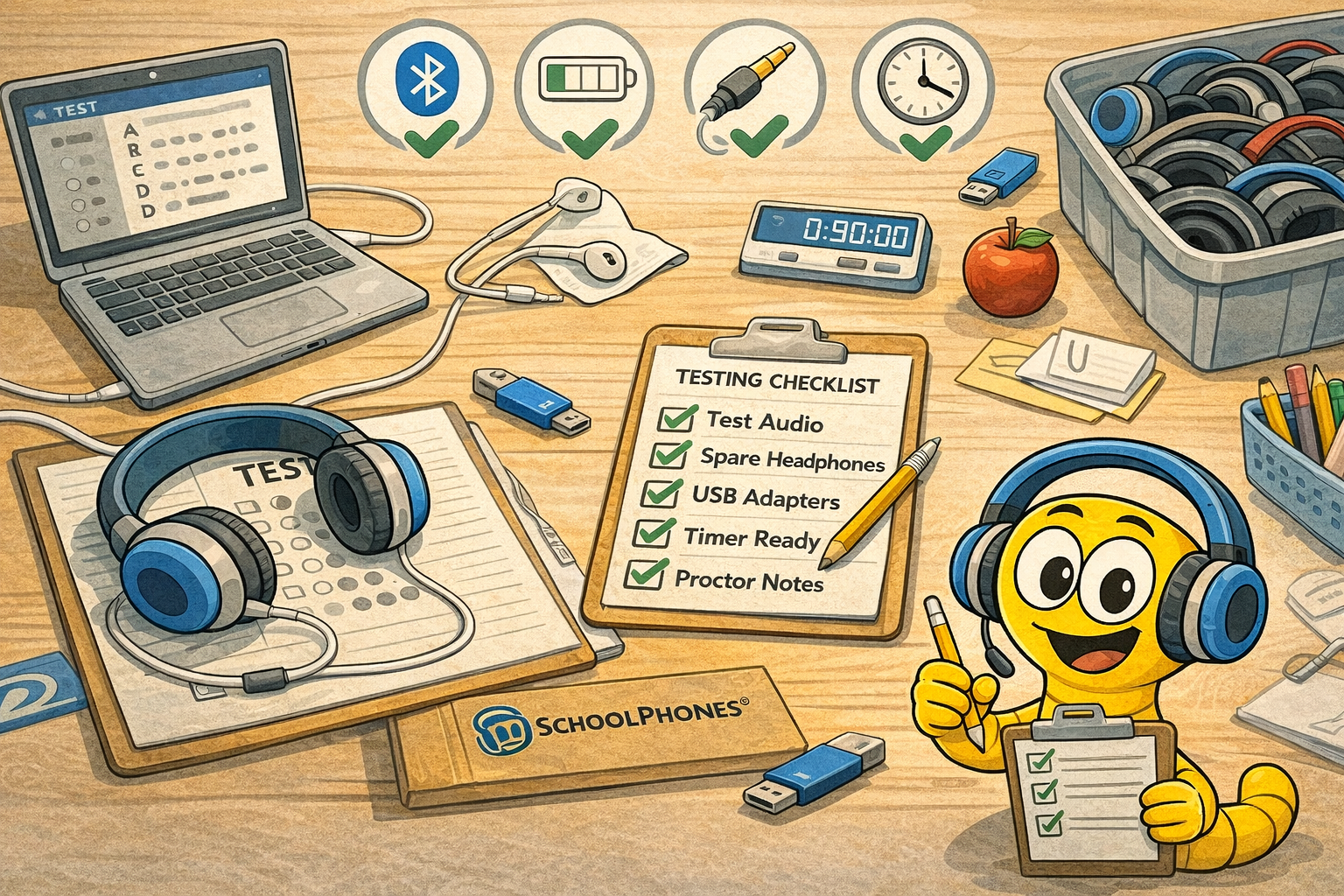
Testing season is the one time of year when headphone failures are absolutely unacceptable. A Bluetooth pairing issue or dead battery during a state assessment can invalidate test sections, create scheduling disruptions, and generate stress for students and staff alike. Here’s your complete guide to headphones for standardized testing, organized by state and testing platform.
State Testing Platform Requirements
Every major state testing consortium either requires or strongly recommends wired headphones. While technical specifications vary by platform, the core recommendation is universal: use wired, over-ear headphones with 3.5mm or USB connections. Bluetooth is explicitly discouraged or prohibited by most testing platforms due to connectivity reliability concerns.
Smarter Balanced (SBAC)
Used in California, Washington, Oregon, Connecticut, Delaware, Hawaii, Idaho, Montana, Nevada, South Dakota, Vermont, U.S. Virgin Islands, and West Virginia. SBAC requires audio for English Language Arts listening tasks and text-to-speech accommodations. Wired headphones are the recommended standard.
STAAR (Texas)
Texas’s State of Texas Assessments of Academic Readiness requires headphones for online ELA sections and accommodated tests. TEA (Texas Education Agency) recommends wired headphones tested in advance on student devices.
NWEA MAP Growth
Used nationwide for adaptive assessments, MAP Growth requires audio for K-2 testing and accommodated sessions. NWEA recommends wired headphones and advises against Bluetooth due to latency and connectivity concerns in large-group testing environments.
Pre-Testing Headphone Checklist
- ☐ Test every headphone on the actual student device 1 week before assessment
- ☐ Replace any headphones with crackling, intermittent, or single-channel audio
- ☐ Verify 3.5mm plugs are fully seated (common issue with cases on devices)
- ☐ Have 10-15% spare headphones ready for test-day failures
- ☐ Label headphones by classroom for easy distribution and collection
- ☐ Brief proctors on troubleshooting: check volume, reseat connection, swap headphone
Choosing Testing Headphones
For standardized testing, prioritize comfort (tests run 60-90+ minutes), speech clarity (listening comprehension sections), and reliability (no failures mid-test). SchoolPHONES® Big Kids and Lab Partner models are specifically designed for extended-wear testing scenarios.
Visit our testing headphones page for detailed platform compatibility information and bulk testing-season pricing.
What the Audio Check Actually Tests
Every computer-based testing platform opens a session with a sound check, and it is where headphone problems surface — at the worst possible moment, with the clock running and a room full of students waiting. The check is simple: the student plays a sample, confirms they can hear it, and where the assessment includes speaking tasks, records a short sample and plays it back.
Three failures account for most of what goes wrong at that step:
- A dead channel. Audio in one ear only, almost always a cable that has been pulled at the plug until a conductor broke. On a headset with a replaceable cable this is a $2.50 fix between sessions rather than a missing seat.
- The wrong input device selected. A headset with a microphone presents as both an output and an input. If the device is still pointed at its internal mic, playback sounds fine and the recording is unusable.
- A microphone out of position. Gooseneck booms drift and stay where they were last bent. The SpringBoom™ boom is a curved steel coil that returns to the same place every time, which is the whole reason it exists.
The practical answer is to run the check the day before, not the morning of. A headset that was plugged in and working yesterday fails far less often than one pulled from a bin ten minutes before the session starts.
Headsets With Microphones for Speaking and Language Assessments
Not every assessment needs a microphone, but the ones that do cannot proceed without a working one. English-language proficiency assessments capture spoken responses, and world-language and speech programs record students directly. For those rooms you want an M-model media headset rather than a plain headphone.
| Room | Recommended | Why |
|---|---|---|
| Reading and listening only | K6S or BKS — $9.35 | No microphone needed; lowest cost per seat |
| Mixed — some sessions need a mic | K6D or BKD — $10.25 | Detachable SpringBoom™ mic, fitted only where required |
| Speaking tasks, ESOL and language labs | K6M or BKM — $16.50 | Fixed SpringBoom™ mic holds position through a whole response |
| Shared lab and listening centers | Lab Partner Jr. LPJ1M | Full-year warranty in shared use, larger 40 mm drivers |
For rooms that run language lab sessions year-round rather than only during testing season, the Lab Partner series is built for it: circumaural cushions for longer wear and a one-year warranty that applies in shared use, which the classroom K6 and BK models do not carry.
How Many Spare Headsets a Testing Lab Needs
Ordering exactly one headset per seat is the most common planning mistake we see. A lab with no spares turns any single failure into a proctoring problem.
- Spare headsets: plan roughly one per ten seats, kept boxed and tested in the testing room itself — not in a supply closet on another floor.
- Spare cables: on D and M models keep a handful of replacement cables on hand. A cable is the part that fails, and at $2.50 it is cheaper to over-order cords than to lose a seat.
- Spare cushions: 50 pairs for $45 covers a large lab for a year and keeps headsets in service that would otherwise look worn out.
Store them where they will actually be used. A Classpack unit holds 25 K6 or BK sets and keeps cords from becoming the tangle that causes next week’s failures.
Hygiene Between Testing Sessions
Testing labs turn over several times a day, often across grade levels, which makes them the highest-contact headphone use in the building. The parts that touch a student are designed to come off: ear cushions are replaceable, disposable hygienic covers can be rotated between sessions, and the headband surfaces are smooth and non-porous so they take a standard disinfecting wipe.
Our headphone care and cleaning guide has the routine, including what to do at the end of testing season before headsets go back into storage.
Before You Order for Testing Season
Requirements are set by your state and your testing vendor, and they change. Confirm against your program’s current guidance rather than any supplier’s summary — including ours. What we can tell you is what the hardware does:
- Wired only. There is nothing to pair and no battery to go flat mid-session.
- Matched drivers across every unit, so the room hears the same thing.
- 85 dB hardware volume limiting on the K6 series for younger students. The BK series is deliberately full range — if 85 dB is in your specification, order K6 and put the model number on the purchase order.
- Repairable rather than disposable, which is what keeps a testing lab staffed with working headsets in year three.
State-by-state and platform detail lives on our headphones for state testing page, and headphones for online testing covers browser-based and remote sessions. When you are ready, the bulk testing headphones range and the bulk order page are the fastest route to a quote or a PO.

Leave a Comment!