
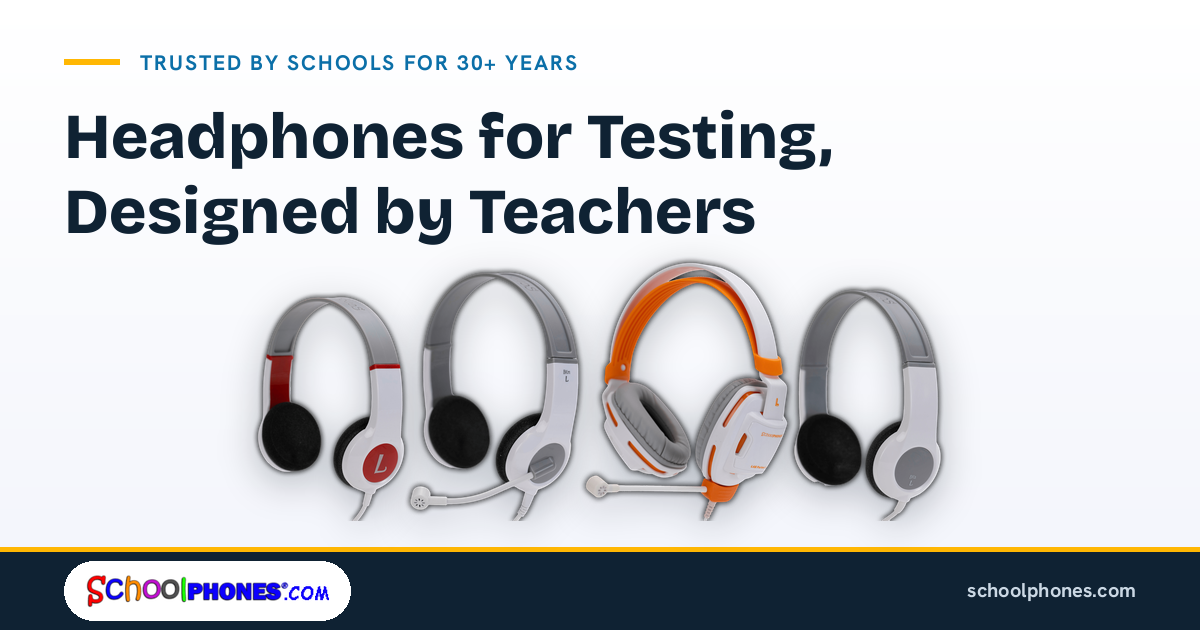
Before SchoolPHONES® made headphones for testing, or headphones for schools of any kind, its founder watched a class of students dig through a pile of six broken headphones looking for the one pair that still played sound. That is the entire origin of the company. Not a market analysis — a bin of dead plastic and a room of children waiting to start.
Three decades later, the question that scene raised is the one schools still ask: what makes school headphones different from headphones you can buy anywhere else? The short answer is that classroom headphones fail for reasons that have nothing to do with sound quality, and every design decision here since has been an answer to one of those reasons. This is the long answer.
What headphones for testing actually have to do
Headphones for testing are wired, individually assigned over-ear headphones that deliver the same audio to every student in a room, survive daily handling by different hands, and can be repaired rather than replaced when one part fails. On a normal day a dead headphone is an annoyance. During an assessment it is a proctor leaving the room, a student sitting idle, and in some programs a session that has to be restarted.
That changes what matters. In a testing lab the requirements stack up in a specific order:
- Consistency across the room. If one student hears a passage clearly and the student beside them hears it thin and quiet, the assessment is no longer measuring the same thing twice. Matched drivers across every unit in a room are the point of buying one model rather than five.
- Surviving the audio check. Every computer-based testing platform opens with a sound check, and it is where broken headsets surface — at the worst possible moment, with the clock running. Headsets that were already plugged in and working the day before fail that step far less often.
- A working microphone, where the test needs one. Speaking-response items and English-language proficiency assessments capture student voice. A mic that drifts out of position mid-answer produces a recording nobody can score.
- Repairability between sessions. A failed unit on Monday should not be a missing seat on Tuesday. If the failure is a cord, the fix should be a cord.
- Something you can clean. Testing headsets get shared between sessions and often between grade levels. Surfaces that wipe down and cushions that come off matter more here than anywhere else in the building.
Requirements that vary by state and platform — which assessments mandate audio, which allow headsets with microphones, what your program says about accommodations — are set by your state and your testing vendor, not by us. Our headphones for state testing page breaks those down by state and platform, and the standardized testing headphone guide covers the assessment programs specifically.
Forty models rejected, and the list that replaced them
The pile of broken headphones could have been solved by buying more headphones. Instead, Ted Simons started bringing commercial models in for teachers to try — teachers at the elementary school his then six-year-old son attended.
Teachers rejected forty commercial models in a row—so we built our own, guided by their 14-point wish list.
Ted Simons, Founder, SchoolPHONES®
Forty rejections is not fussiness. The teachers doing the rejecting were not grading sound stages; they were predicting Tuesday morning. They knew the cord would be yanked, the headband would be sat on, thirty pairs would go into one bin, and the same set would be on a different child’s head by Thursday. Consumer headphones are not wrong, exactly. They are built for one owner who cares about them.
What came out of those sessions was a 14-point list describing what a school headphone has to survive. Four of its items are still visible in every product we make:
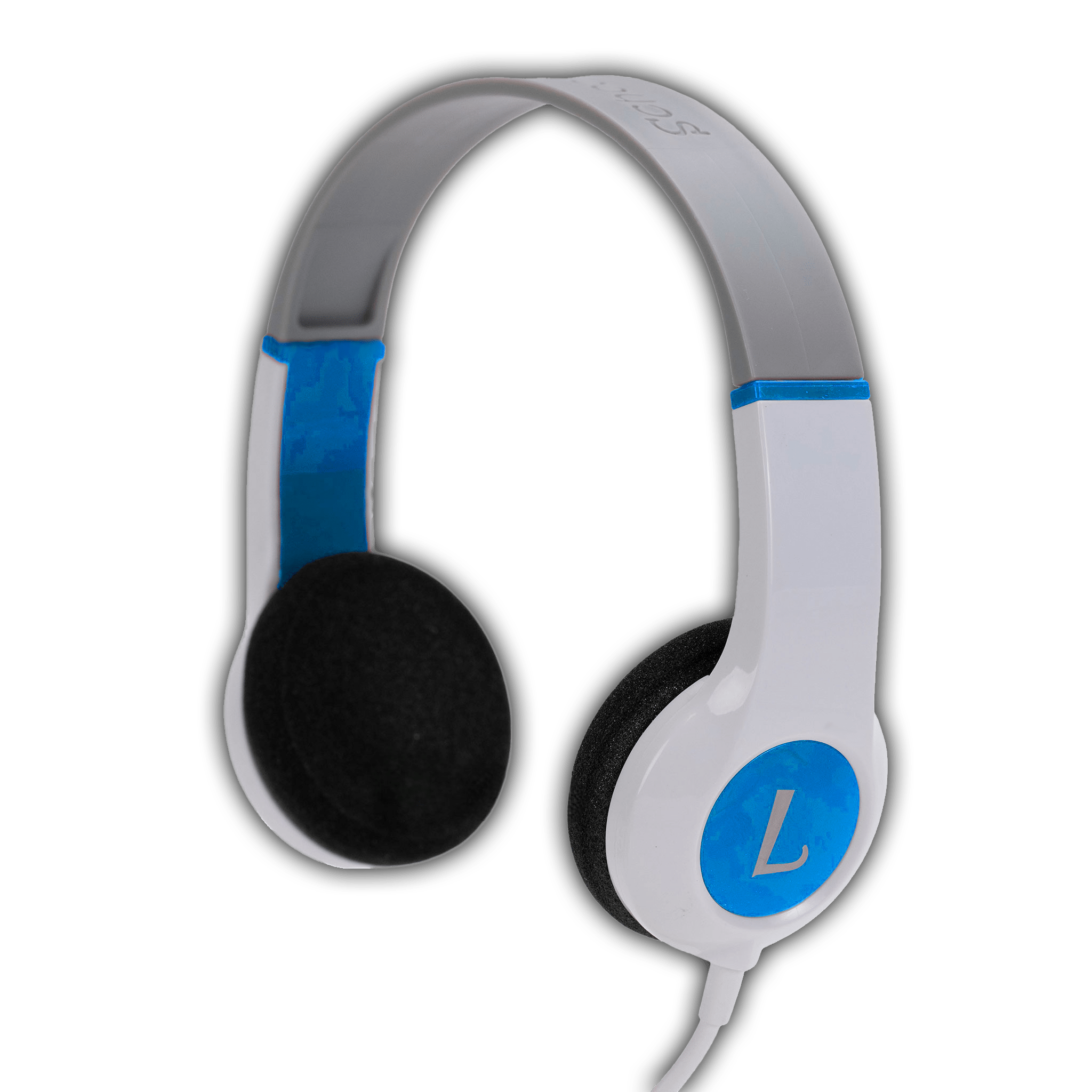
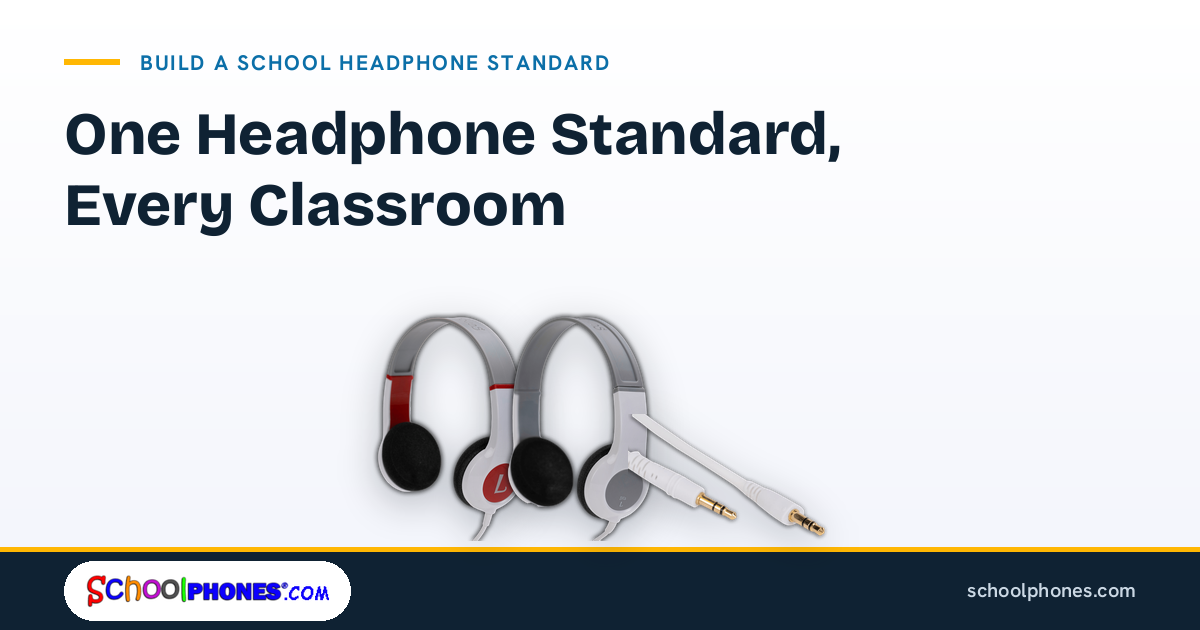
- Size options. One headband does not fit a Pre-Ker and an eighth grader. That single requirement is why the line splits into two series instead of one.
- Single-entry cables. A cord entering one earcup instead of both is a cord that does not braid itself into the next three headsets in the bin.
- Lice-resistant ear pads. Shared headphones move between heads. Teachers wanted pads that come off and get replaced, not fabric that has to be thrown away with the headset attached to it.
- A 1.2 m lead. Not longer. Long cords tangle, catch on chair backs, and pull devices off desks.
That list is still the specification. The product line is now in its fifth generation, and the method has not changed: where a generation showed a weakness, the next one corrected it. The full account of how SchoolPHONES® approaches design lays out the principles; what follows is what they produced.
Fit is a specification, not a grade label
The most common ordering mistake we see is buying one model for a whole building. Head size does not follow grade neatly, and a headset that does not seal properly is both uncomfortable and quieter than it should be — which is exactly when a student reaches for the volume.
| K6 series | BK series | |
|---|---|---|
| Sizing, center to center of the speakers | about 13–15 in | about 14–16 in |
| Designed for | Younger students, Pre-K through early middle school | Older students, teens and adults |
| Maximum output | 85 dB hardware limited | Full range, not limited |
| S model — fixed cable | K6S — $9.35 | BKS — $9.35 |
| D model — replaceable cable, optional mic | K6D — $10.25 | BKD — $10.25 |
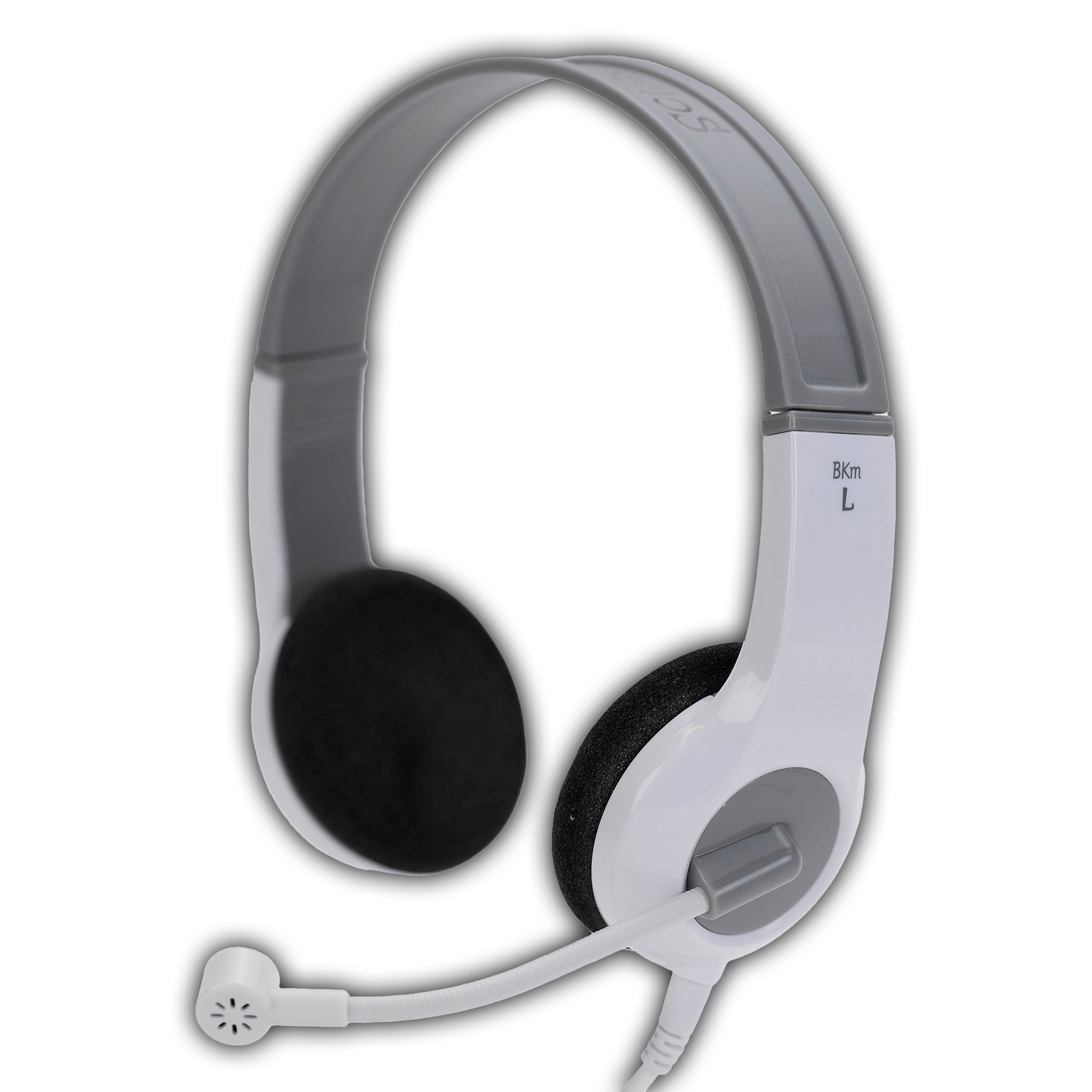
| M model — media headset, fixed SpringBoom™ mic | K6M — $16.50 | BKM — $16.50 |
One row in that table deserves to be read twice, because it is the detail most often misquoted about our products. Volume limiting is a K6 feature, not a line-wide one. The K6 series uses a passive resistor circuit that caps output at 85 dB in hardware, so it cannot be overridden by a student who has worked out the settings menu. The BK series is deliberately full range, because older students use the same headsets for music and media production where a hard cap gets in the way.
If your specification says 85 dB — the continuous-exposure ceiling the CDC and NIOSH recommend — you want K6, and you should write the model into the purchase order rather than the series. The reasoning behind the number is in our guide to volume-limited headphones for kids, and the K6 versus BK sizing guide has the measurements. For a sanity check before ordering, measure a few actual students rather than trusting the grade column.
Classroom headphones get replaced by the cord, not the headset
Ask a technology coordinator what actually fails and the answer is almost never the headband. It is the cord: yanked from the jack, rolled over by a chair, wrapped too tight around the cups for a year. On a sealed consumer headset, a dead cord is a dead headset.
The D and M models are built around that fact. The cable is a separate part, and a standard replacement cable is $2.50 against a headset at $9.35 to $16.50. A district that loses fifty cords a year replaces fifty cords a year, which is the difference between a line item and a budget request. Ear cushions work the same way — 50 pairs for $45 rather than fifty new headsets.
The headband was solved differently. It is a proprietary malleable polypropylene blend chosen to bend rather than snap. We demonstrate this by abusing them at trade shows — tying them essentially in knots, some of them surviving months of it and going back in the case for the next show.
Why throw away a perfectly good headset for a new port standard?
Ted Simons, Founder, SchoolPHONES®
Wired by design, and staying that way
SchoolPHONES® does not sell Bluetooth. In a room of thirty students, pairing is a class period you do not get back, charging is a cart nobody has space for, and a flat battery on testing day is a seat that cannot be used. Wired headsets work the moment they are plugged in, every time, with no state to manage.
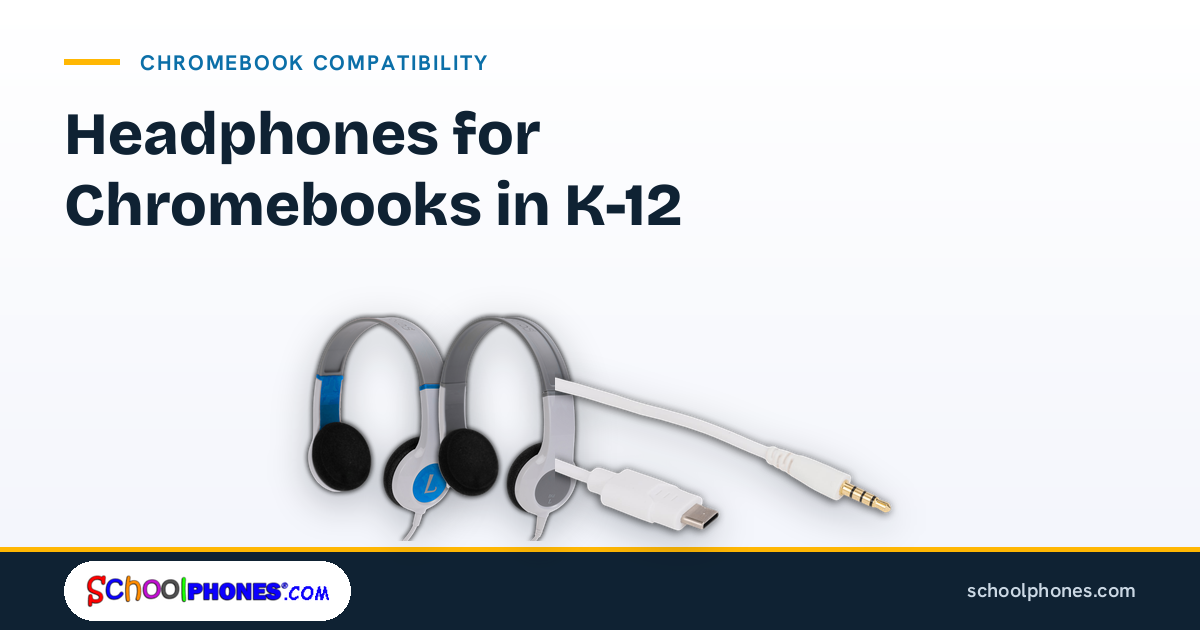
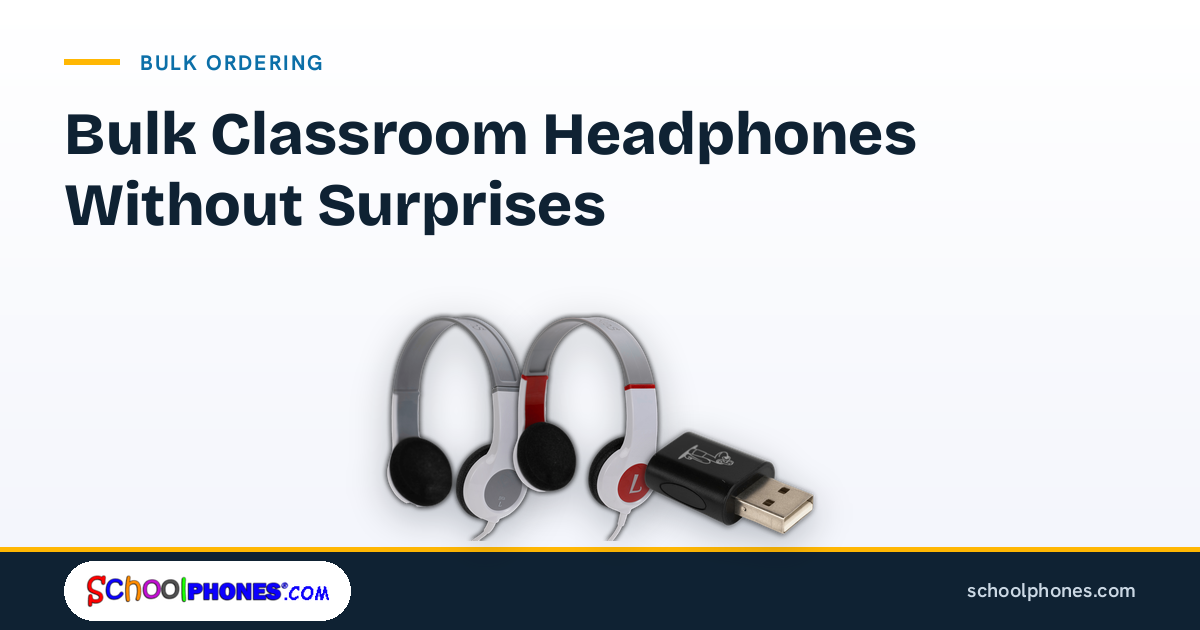
Device compatibility gets handled at the cable instead. When Chromebooks and tablets began dropping the headphone jack, districts running D and M models bought cables rather than headsets: 3.5 mm TRS and TRRS, USB-A, USB-C, 110-degree angled plugs that clear a desk edge, and magnetic breakaway cables that release instead of taking the device with them. The replaceable cable range is the reason a port change is a cable line item here.
One honest wrinkle worth knowing before you order: analogue headsets with microphones use different plug wirings, and not every device expects the same one. That is why we stock inexpensive conversion adapters alongside the cables. If you are standardizing a mixed fleet, check the device pages before you buy in quantity rather than after.
- Headphones for Chromebooks and computers — plug-and-play wired audio across ChromeOS, Windows and macOS
- Headphones for iPads — USB-C and 3.5 mm by model
- Headphones for tablets — the cross-brand compatibility rundown
- Headphones for online testing and remote learning — what browser-based sessions need
Shared use, hygiene, and what the warranty really covers
A testing lab is shared use by definition, and we would rather be plain about what that means than let you discover it later. On the K6 and BK series and their accessories, the warranty runs one year in single-student use and 90 days in shared use. The Lab Partner Jr. series and its accessories carry one year in both cases — which is precisely why the Lab Partner Jr. line exists and why we point labs and listening centers at it rather than at the classroom models.
Claims are deliberately unbureaucratic. Send a photo of the damage with a short description — no RMA number, no return authorisation paperwork before anyone will speak to you. Intentional damage and abuse are not covered, and we will say so rather than quietly deny it.
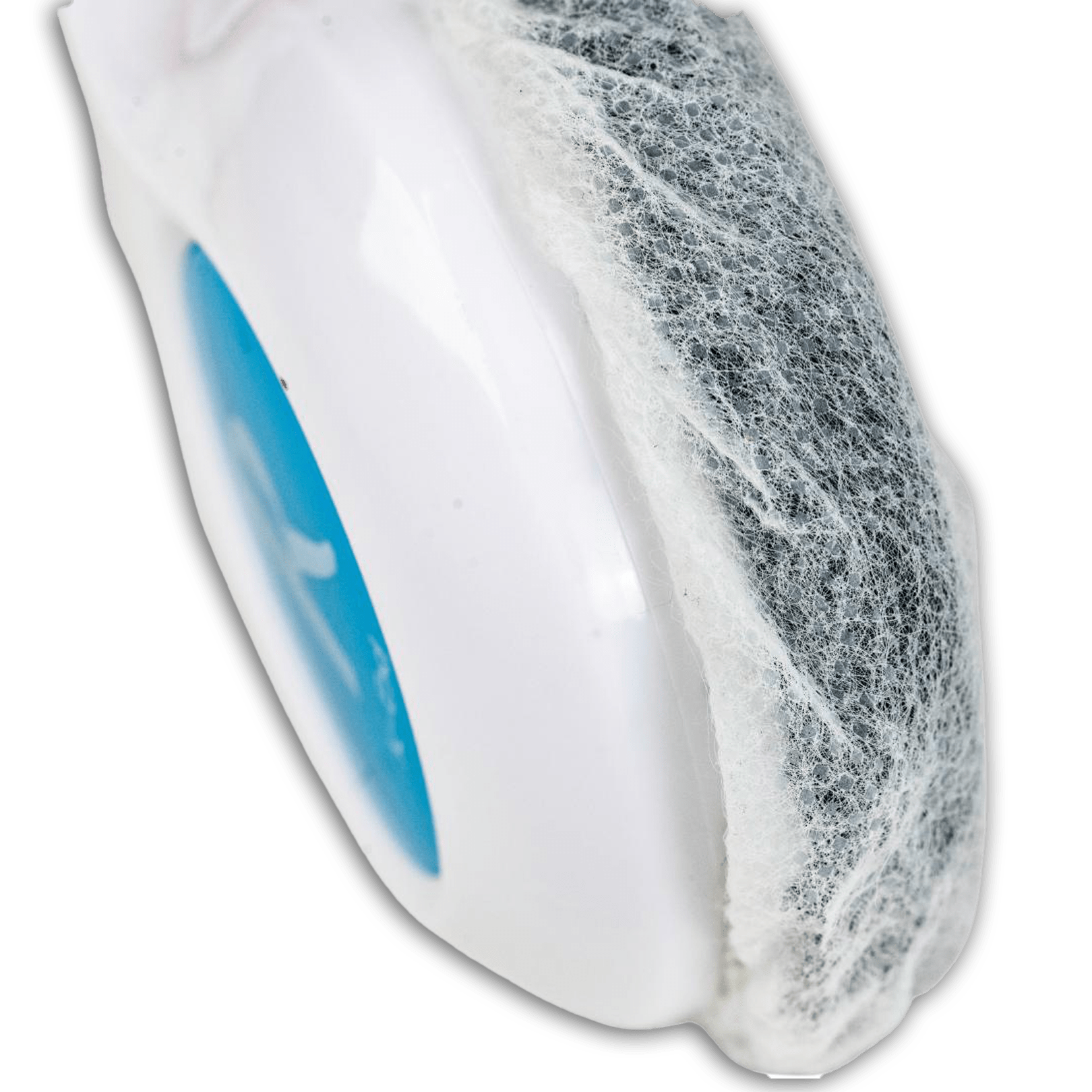
For hygiene, the parts that touch a student come off. Ear cushions are replaceable, disposable hygienic covers are available for rotation between classes, and the headband surfaces are smooth and non-porous so they take a standard disinfecting wipe. Our headphone maintenance and care guide has the actual routine, including the end-of-year reset. A Classpack storage unit holds 25 K6 or BK sets, which is what stops a cart becoming the tangle the 1.2 m cord was meant to prevent.
The same price whether you buy one or a thousand
There is no volume tier here, no district rate, and no minimum order. One headset and one thousand headsets cost the same per unit. A single teacher buying a class set out of her own pocket pays what a 40,000-student district pays.
That is a consequence of how the company is built rather than a promotion. We sell manufacturer direct, with no advertising spend, no distributor margin and no field sales force to fund. There is nobody to call your district, which is the trade: you get the price, you do not get the visit.
Two practical notes. Purchase orders are accepted — the bulk order page is the fastest route for a PO or a quote, and our district purchasing guide covers how to structure a standardization order. And since 2025 we have listed any import tariff as a separate surcharge line on the invoice rather than folding it into the unit price, adjusted shipment by shipment, because duty is not knowable until a container physically clears customs. It is a line you can see and question, which is the only version of that we were willing to ship. The full tariff explanation is public.
2026: raise prices on schools, or stay home
That surcharge came out of a genuinely bad year. Tariffs on what we import have run around 20% on headphones, and on some replacement components well over 100%. There were two available responses: raise prices, or find the money elsewhere.
We found it in our own travel. Conferences had been the best thing we did — the place we met the teachers whose complaints became the next generation of product. Cutting the exhibition schedule redirects more than $40,000 a year toward absorbing tariff cost instead of passing it to schools. It was the right call and it cost us something real: fewer new teachers discover us now, which is why the letter explaining it ends by asking the educators who already know us to tell their colleagues. We still came to ISTE, because the booth was already booked and because a year without meeting any teachers at all was not something we were willing to do.
Choosing headphones for schools, 30 years on
Strip away the history and the practical advice is short:
- Testing labs and media work — an M model, K6M or BKM. The fixed SpringBoom™ mic holds position through a speaking task because a curved spring returns to where it started, and a student cannot push it into their mouth.
- Whole-building standardization — a D model, K6D or BKD. Replaceable cables mean the next device refresh costs you cables, and the mic is there when you need it.
- Tight budget, no mic needed — an S model, K6S or BKS at $9.35. Fixed cable, same headband, same drivers.
- Shared labs and listening centers — Lab Partner Jr., for the full-year shared-use warranty and the larger drivers. Add a 4-way splitter for a listening center.
- Under about grade 4, or an 85 dB requirement — K6, every time.
What has not changed in more than 30 years is who decides what gets built. The 14-point list was written by teachers who had run out of patience with headphones designed for somebody else, and it is still the document the products answer to. If something in your classroom is failing in a way we have not thought of, that is the same conversation that started all of this — tell us, or call 800-286-3481.
Ready to order? The bulk testing headphones range and the headphones for schools category are the fastest way in, and the Knowledge Center has the care, sizing and compatibility articles in one place.
Frequently asked questions
Are SchoolPHONES® headsets approved for state testing?
We make no approval claim, and you should be wary of any supplier who does. Approval is defined by your state and your testing platform, not by a manufacturer. Our headsets are designed for assessment use and schools use them for computer-based testing, but check your program’s current guidance before ordering. The state testing requirements page is a starting point, not an authority.
Which models are volume limited to 85 dB?
The K6 series only. It uses a passive resistor circuit that caps output in hardware, so a student cannot override it in software. The BK series is deliberately full range for older students doing music and media work. If 85 dB is in your specification, order K6 and write the model number on the PO. More in the volume-limited headphones guide.
Do you sell Bluetooth or wireless classroom headphones?
No, and we do not plan to. The line is wired by design — nothing to pair, nothing to charge, nothing to go flat on testing day. Device compatibility is handled at the cable instead, with 3.5 mm TRS and TRRS, USB-A, USB-C, angled and magnetic breakaway options.
Is there a minimum order, and do large districts pay less?
No minimum, and no. The per-unit price is identical for one headset or a thousand. There are no volume tiers and no separate district rate, because we sell factory direct. Purchase orders are accepted through the bulk order page. Note that import tariffs appear as a separate surcharge line rather than inside the unit price.
How do I choose between the K6 and BK series?
Measure rather than guess. K6 sizes at roughly 13 to 15 inches center to center of the speakers and suits younger students through early middle school; BK runs about 14 to 16 inches for older students, teens and adults. Mixed-age buildings commonly order some of each. The sizing guide has the detail, and remember the volume-limiting difference above.
What does the warranty actually cover in a shared lab?
On K6 and BK models and their accessories, one year in single-student use and 90 days in shared use. The Lab Partner Jr. series and its accessories carry one year in both, which is why we recommend it for labs and listening centers. To claim, send a photo of the damage with a short description — there is no RMA process to navigate first. Intentional damage is excluded.
What happens when our next device refresh drops the headphone jack?
On the D and M models you order cables, not headsets. That is what made the USB-C transition a cable line item rather than a fleet replacement for districts already running them. Start with the Chromebook and iPad compatibility pages for your specific models.

Leave a Comment!